
The Australian National University (ANU) School of Engineering researchers and students showed off the creative ideas and practical solutions from their 2025 Capstone group, internship, and research projects.
Held in October, the Semester 2 2025 ANU College of Systems and Society Showcase brought together final-year engineering students and researchers with industry partners and academic advisers to celebrate projects that tackle real-world challenges through technology.
The event highlighted the depth and diversity of work underway across the ANU School of Engineering, from assistive technologies and disaster resilience to creative robotics and advanced materials research.
Student projects
The Capstone Design Project course is a hallmark of the ANU engineering curriculum. Through Capstone, final-year students work in teams to deliver real-world engineering solutions, guided by industry partners and academic mentors.
To mark the culmination of their year-long projects, students presented their work at the 2025 Capstone Showcase. Awards on the day recognised projects that demonstrated technical excellence, innovation and real-world impact for industry clients.


Project Ver
Engineering Capstone 1st Prize (supported by Waste Check Australia Pty Ltd)
Team: Sam Eckton, Callum Edmiston, Harriet Furphy, Holly Jacob, Sarah Turner, Andrej Videnovic
Project VER aims to develop an AI-powered assistive device for people with low or no vision. Delivered in collaboration with Vision Australia, Guide Dogs and Ebe Ganon, the project builds on previous ANU student prototypes to design and develop the next iteration of a small, wearable navigation aid.
The team focused on improving usability and functionality to better support everyday navigation for the low vision community.


Connectivity for community disaster resilience: Flood detection network
Engineering Capstone 2nd Prize (supported by Waste Check Australia Pty Ltd)
Team: Stana Fernandez, Aananya Jha, Liam McPherson, Lily McPherson, James Menham, Jerry Yu
The Community Flood Intelligence Network project seeks to improve early flood detection in flood-prone communities. The system uses a decentralised network of rain gauges and creek-level sensors to deliver reliable, real-time data to local users.
Designed to operate off-grid and independently of cellular infrastructure, the network continues to function during power outages and communication failures. This iteration of the project focused on improving communication range to strengthen the delivery of timely flood intelligence.
The initiative supports proactive decision-making for emergency services and communities, helping to minimise risk and enhance disaster resilience.


Project Grover
Engineering Capstone 3rd Prize (supported by the ANU College of Systems and Society)
Team: Hayden Clements, Kaveesha Jayaweera, Duncan Nutt, Isaiah Prichard, Jesse Stevens, Lewis Teasey
Project Grover explores the development of an autonomous robot capable of creating large-scale artwork across landscapes. Inspired by geoglyphs, artworks traditionally formed by altering natural materials such as stone or sand, Grover instead uses line-marking paint to create patterns visible from above.
By combining robotics, autonomy and creative expression, the project pushes the boundaries of how and where art can be made.
Researcher projects
Early Career Researchers (ECRs) and Higher Degree by Research (HDR) students from the ANU School of Engineering also shared their work, with awards recognising research excellence and industry relevance.
HDR Industry 1st Prize (supported by Vector Alliance)
Olivia Wisniewski for Method for quantitative assessment of Intraoperative Patellofemoral Kinematics.
HDR Industry 2nd Prize (supported by Vector Alliance)
Ahmed Afifi for Spatiotemporal Erosion Mapping and Modelling in Space Electric Propulsion Systems
ECR School Award 1st Prize (supported by the ANU School of Engineering)
Yuxuan (Richard) Zhang and Lijin Chen received first prize among the School’s ECR’s for their presentation on Biomimetic Designs for Advanced Hydrated-Based Carbon Capture, Storage and Transport.

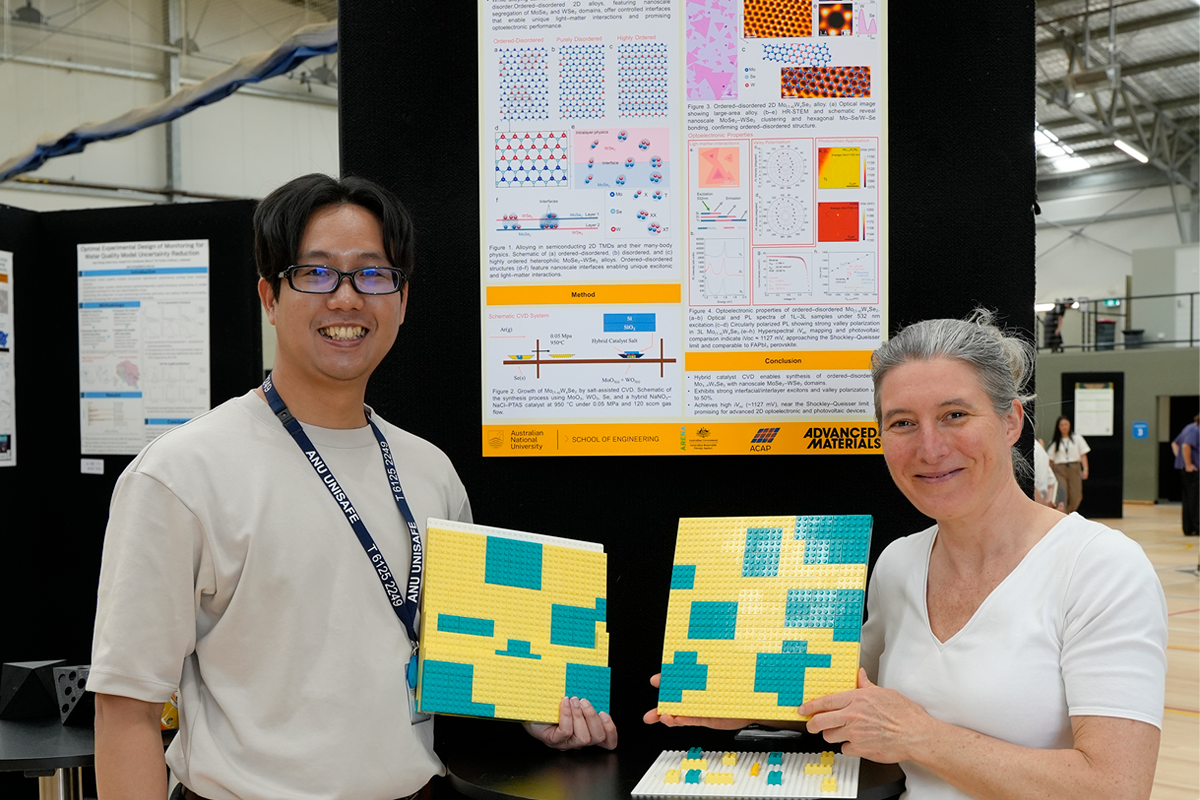
ECR School Award 2nd Prize (supported by the ANU School of Engineering)
Ary Wibowo was recognised with the ECR 2nd prize for Synthesis and Light-Matter Interaction of Low-Dimension Ordered–Disordered Layered Semiconductors.
Well done to all the students and researchers who showcased their work, and thank you to the industry partners, supporters and attendees who helped make the 2025 showcase a success.