
Bingcheng Xiao first walked into their university life planning to tell stories through film.
But somewhere between writing scripts and directing shots, they discovered a new type of storytelling; explaining science to the world.
Now studying at the Australian National Centre for Public Awareness of Science (CPAS), they’re finding a lot more common ground between film directing and science communication.
Behind the camera
Bingcheng’s journey started with their undergraduate studies in China, focusing mainly on television and film directing. They produced many short-length films and documentaries with themes from tea to ancient towns.
On top of this, they were also an avid travel vlogger over social media.
"These experiences helped me tell stories through images, interviews, editing, and rhythm. Documentary-style work is especially interesting because I could observe real people, places, and cultures, and then turn those observations into a story that audiences can connect with.”
After a two-year gap, Bingcheng become a postgraduate student at The Australian National University (ANU). Although excited to enter the world of science communication, a quiet worry lingers for them.
"ANU has the best resources and studying atmosphere in liberal arts and science communication. However, I worry that it might be a challenge to study science communication since I don’t have a strong background in STEM.”
Thankfully, Bingcheng finds great similarities crossing over their two worlds.
“Both science communication and film studies are about communication. They require us to think about the audience, how to organise information, and how to make complex ideas easier to understand.”
“My background in media helped me become more sensitive to storytelling, audience engagement, and visual communication, which I think are also useful in Science Communication.” They added.
“Writing scripts, filming, editing, and production promotion were very useful – focusing on camera angles, visual effects, and other hands-on techniques. But behind these skills, the main goal was always to express ideas, emotions, and perspectives.”
Although science communication is grounded in STEM, many CPAS courses aim to be accessible, whether you’ve come from STEM, media, education, or any other related backgrounds.
Meeting the mentors

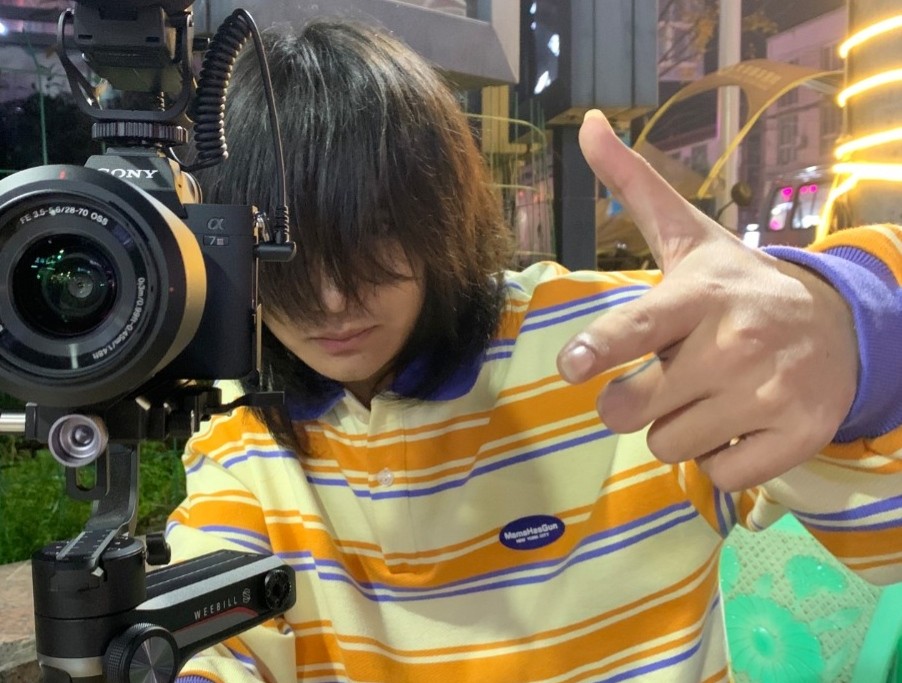
Bingcheng’s favourite part about being a student at ANU are the professors.
“Learning under Associate Professor Will Grant and Dr Laura Dawes is incredible, they bring a strong presence in the classroom, and I feel encouraged and respected throughout my studies.”
“Dr Graham Walker feels like a wise mentor - someone with a quiet brilliance and a lifetime of insight, whose guidance I truly value.”
They are also very excited to work with science communicators like Dr Anna-Sophie Jürgens for her work in popular culture, Dr Matt Nurse’s research on misinformation, and Dr Brad Tucker’s work at the intersection of science fiction and science.
Recently, Bingcheng has become more occupied with their research project.
“With Dr Rini Astuti’s guidance, I am learning how to become an early-career researcher.”
“Others encouraged me to look into ethnography-related research. It’s interesting because it has some similarities with documentary filmmaking. Both involve observation, people’s lived experiences, and understanding a specific social or cultural context.”
Over the next year, Bingcheng hopes to improve their research skills and apply for a PhD at CPAS.
“My goal is to work towards publishing a paper and to gain more hands-on research experience, especially in areas that were not a strong focus in my undergraduate studies."
Rewriting the script
Getting into STEM wasn’t easy in the beginning. Bingcheng admits that it was their lack of knowledge that made them hesitant of science at first.
“One of the biggest misconceptions that I faced when first stepping into science communication was telling people who did not understand science what ‘real science’ was.”
After a semester of study, Bingcheng learned that there was more to science communication than what meets the eye.
“Sometimes, deviations from real science in science fiction films are not necessarily harmful. For example, the colour of sunlight depicted on Mars in The Martian differs from physical reality, yet such creative choices can serve narrative purposes rather than undermine public understanding.”
Bingcheng’s current research focus is on medical paper retractions and the effect on trust in science for young adults in China.
"It looks at how flawed medical paper corrections are framed, and how these may influence young adults’ trust in science in China. I think this topic is meaningful because it connects with questions about scientific errors, media narratives, and public trust in science.”
“Although this topic is different from documentary or pop-culture research, I still see a connection with my media background. It is still about how information is presented, how people understand it, and how communication can shape public attitudes.”
For anyone who is considering taking a Masters in Science Communication, Bingcheng leaves you with wise insight.
“The Science Communication program is challenging and motivating. For me, the program pushed me well beyond my comfort zone, but I learned an enormous amount through that process. The skills and perspectives I gained are ones I expect to carry with me for life.”
You may also like

Celebrate 80 years of ANU with us
Join us in celebrating 80 years of the ANU.

80 YEARS TOGETHER.
Explore our 80th anniversary celebrations and get involved.

Meet the ANU College of Systems and Society 3MT 2026 finalists
Okorite Itumo and Liye Fu will take to the stage on Friday for the ANU 2026 3 Minute Thesis (3MT) finals. Get to know them ahead of the event.